Recognizing When Technology Can’t Solve the Organization’s Problems
The rush to implement artificial intelligence has me thinking about a lesson learned: organizations often look to technology to solve problems that technology simply cannot fix.
I've seen it in enterprise transformation. But where it hit home, was when I saw it firsthand in nonprofit leadership. I experienced it with my beloved Brown Dog Foundation. Our mission was to help families experiencing temporary financial crises access lifesaving veterinary care for their pets. We built a model around the premise: a non-profit could provide grants to families and they could repay that assistance over time, which would in turn sustain the program and extend its reach to help those who could not repay.
The model was thoughtful. The need was real. And we found people who believed in what we were doing. But securing significant, sustained and significant funding was altogether a different matter. Much of the philanthropic funding landscape was organized around clearly defined populations: people experiencing poverty, older adults, people with disabilities, and other established categories of need.
A family experiencing a temporary financial crisis didn't fit as neatly into those categories. Their circumstances could be complicated. Their need was temporary and "messy." Their ability to repay invited questions. And the very idea of helping someone who was struggling financially, but didn't fit a familiar definition of 'at risk' made prospective supporters uncomfortable.
We defined eligibility criteria easily, using federal narratives. We built responsible automated processes and systems. We demonstrated the need.
But we couldn't make people want to fund the mission. That was the barrier we couldn't engineer our way around.
The people holding the purse strings had their own priorities, assumptions, and ideas about which problems deserved their philanthropic dollars. We could make our case, but we couldn't control the lens through which it was received. And that is an uncomfortable reality for anyone trying to build something new: the merit of an idea and people's willingness to support it are two entirely different things.
This is where rhetoric, bias, and deeply held assumptions matter. The way we talk about people in need influences how we perceive them. The categories we create influence whom we recognize as deserving of help. And the stories we tell about personal responsibility can shape whether we see a struggling family as worthy of assistance or as someone who should simply manage their circumstances differently.
No technology will ever resolve those human judgments for us - not a CRM tool, and not Artificial Intelligence. That experience reinforced a lesson I've carried throughout my career: organizations don't always have technology problems. Sometimes they have problems rooted in human behavior, organizational culture, competing incentives, or the assumptions that shape decisions.
And that brings me back to AI.
We can build increasingly sophisticated systems to analyze information, automate processes, and support decisions. But technology doesn't eliminate bias simply by being technology. Human assumptions can influence the data, the design, the implementation, the objectives, and the decisions made using its output. If technology alone could solve these problems, discrimination wouldn't exist. Bias wouldn't shape opportunity. And good ideas wouldn't struggle simply because the people with the power to advance them weren't persuaded they were worth supporting.
Technology can help us identify problems, improve processes, and make better-informed decisions. But it cannot independently change what people value, what they believe, or what they are willing to do. Transformation begins when we understand the actual barriers—not just the ones technology is equipped to address.
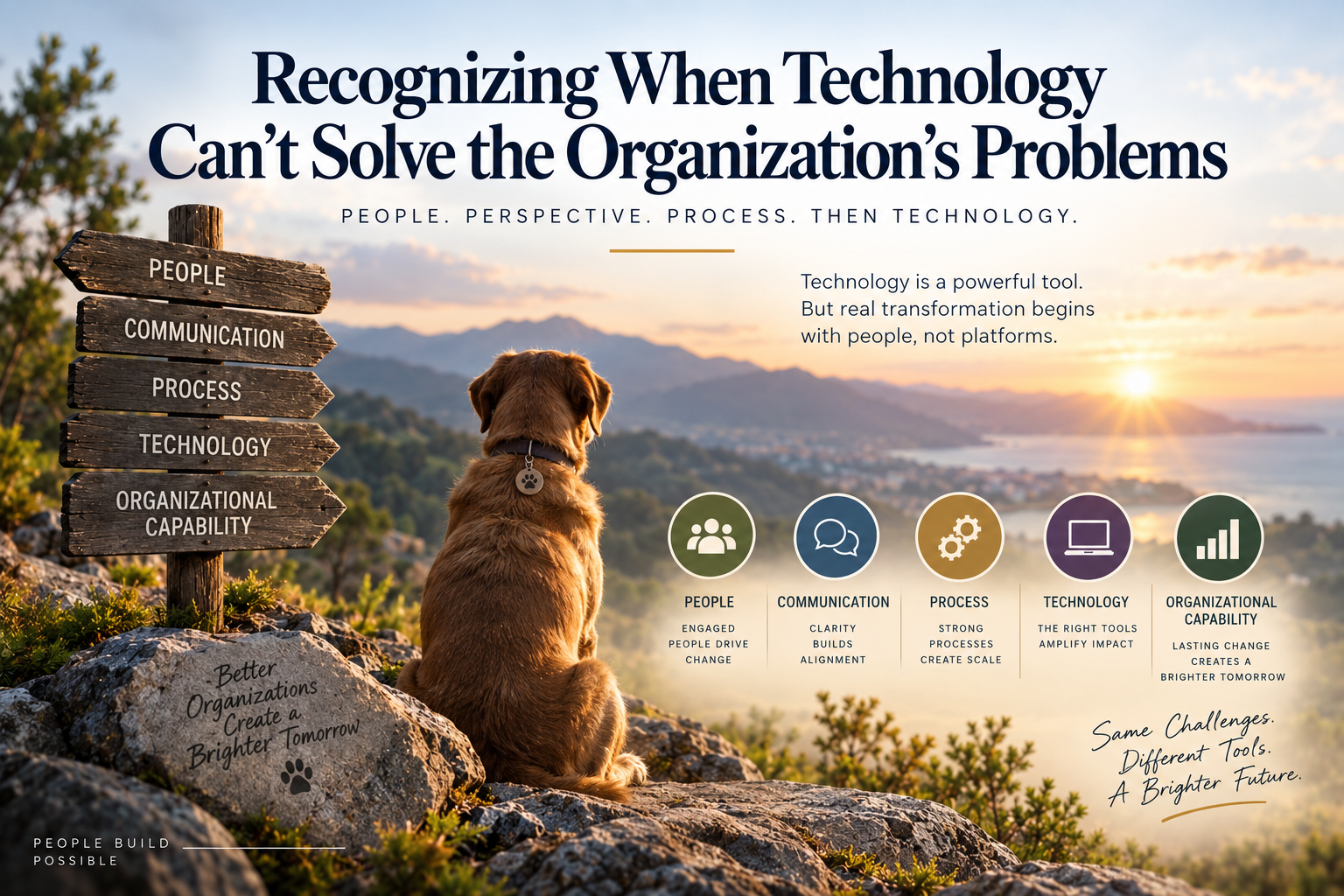
People. Communication. Process. Technology. Organizational capability. The order matters. Because successful transformation isn't measured by what an organization implements. It's measured by what the organization becomes capable of accomplishing—and whether it is willing to confront what has been standing in the way.
The problem is sometimes bigger than the organization
I've encountered this reality in two very different missions.
At Brown Dog Foundation, we struggled to secure sustained philanthropic investment for a model designed to help families through temporary financial crises while making assistance more sustainable over time.
At TechFluent, I saw the challenges of building workforce pathways in an ecosystem where funding, employer demand, hiring conditions, and the pace of technological change don't always align.
Different missions. Different operating models. A common challenge. The ecosystem surrounding an organization can be just as influential as the organization itself. Funders decide which problems receive investment. Employers decide which skills they value and whom they hire. Institutions establish priorities. Public narratives influence which populations receive attention and which solutions are considered viable.
Organizations must navigate all of that while trying to deliver on their missions. No technology can independently reconcile those competing interests. No process redesign can guarantee that the people with the resources to support a mission will choose to do so. Technology can make an organization more effective. It cannot, by itself, make its ecosystem more willing to support the work.
That requires human decisions, changed priorities, and a willingness to confront the assumptions that shape them. And that is why meaningful transformation must begin with understanding the problem in its entirety—not simply identifying the next tool that promises to solve it.